

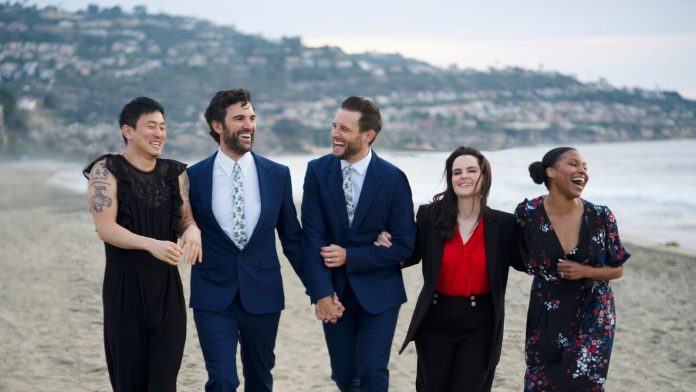

In the world of filmmaking, the drive to narrate meaningful stories that resonate with audiences is a shared goal among screenwriters, directors, and storytellers. This aspiration is clearly evident in Andy and Danny Vallentine’s feature film debut, *The Mattachine Family*, which holds significant meaning not only for them but also for their community.
*The Mattachine Family* offers a nuanced exploration of queer families and evolving concepts of parenthood. The film follows Thomas (played by Nico Tortorella) and Oscar (portrayed by Juan Pablo Di Pace) as they navigate their changing perceptions of parenthood after fostering a child. Through this narrative, the Vallentines delve into what family-making looks like for queer couples. The film’s impressive ensemble cast underscores its thoughtfully executed theme. While Thomas’s character finds support within his community, the Vallentines fostered their own supportive production team to bring this heartfelt story to life.
Ahead of their film’s screening at the Outfest Film Festival in Los Angeles, CA, Andy and Danny Vallentine spoke with No Film School. They shared their creative inspiration, the balance in their artistic collaboration, and essential insights for indie filmmakers on set.
### THE MATTACHINE FAMILY (Clip) – Frameline47
**Editor’s Note: The interview has been condensed and edited for clarity.**
**No Film School:** Congratulations on the film’s success at numerous film festivals. It’s truly special, and I hope everyone has the opportunity to see it. Can you share the inspiration behind the story and the journey to making it a feature-length project?
**Andy Vallentine:** Danny has always been a writer, and I’ve been a director. We’ve been married for nearly a decade, but our creative collaboration only began about five years ago, after spending some time in the industry. We wanted our first indie film to be personal and within our expertise. We reflected on our relationship and realized our most challenging discussions revolved around our future together, like whether we wanted children.
**Danny Vallentine:** These conversations were incredibly insightful for understanding our lives. I searched for films that depicted our experiences but found few about men becoming parents. To explore these questions and fill that narrative gap, we began writing this film. Many elements of the story, including Thomas’s journey into fostering and adoption, stemmed from real conversations with our friends. The film reflects various queer family dynamics, inviting audiences to relate beyond a single narrative.
The diversity in family-making naturally unfolded because our friends have adopted, fostered, and used surrogacy. The film mirrors those experiences, asking what it means to be a queer parent and what family-making looks like today, blending chosen family ideals with emerging possibilities.
For queer couples, the path to parenthood involves more discussion. We set Thomas on a journey to discover the diverse ways queer people can become parents, meeting characters like Annie (played by Funke) who have their own fostering experiences.
**NFS:** I appreciated the film’s narrative structure, combining traditional storytelling with voiceover inserts. Was this approach part of the initial writing process?
**Danny Vallentine:** Yes, we called them narrative narrated sequences from the start. We wanted to incorporate Thomas’s perspective as a photographer. It was a natural way to explore his thoughts and connections to his past and family through photography.
**NFS:** You collaborated with Sean Cook to create the film’s striking images. What was that experience like?
**Danny Vallentine:** Sean was my college roommate at Michigan State.
**Andy Vallentine:** Sean, a talented wedding photographer from the Midwest, captured our own wedding in Paris. I wanted Thomas’s photographic eye to differ from mine and Julia Swain, our cinematographer. Sean’s unique perspective helped us create fresh visuals distinct from my own.
Sean joined our production for six days, capturing all the photos. It was a logistical feat, shooting scenes while Sean simultaneously took photos in another room. Having him involved, someone we’ve known for 23 years, was a wonderful experience.
**NFS:** It truly seems like a family endeavor. How long was the film’s principal photography?
**Andy Vallentine:** It spanned 20 days, with a pick-up day in New York for a montage scene with Nico. Most indie films shoot between 15 to 25 days. We faced challenges, balancing big creative ideas with available resources. Some days were perfect, capturing every detail as envisioned, while others demanded quick work due to budget constraints.
**NFS:** Challenges are inevitable. What unexpected obstacles did you face, and how did you overcome them?
**Danny Vallentine:** Although we had done a short film together, writing this feature was a new challenge. Initially, I wrote my ideal version of the story, but collaborating with Andy meant adjusting scenes to fit budget and production realities. Letting go of cherished elements was tough, but ultimately, collaboration improved the script.
**Andy Vallentine:** One logistical challenge involved a scene written for a mansion in Michigan. Budget restrictions forced us to relocate to a motel in Los Feliz, limiting my initial vision. However, with script adjustments, Nico Tortorella and Juan Pablo Di Pace delivered a captivating performance in that single room.
**NFS:** How do you support each other creatively during challenging moments?
**Andy Vallentine:** We’ve been together for nearly 14 years, so we know each other well. While we sometimes spiral together, Danny is my calming influence. His steadiness reassures me during crises.
**Danny Vallentine:** I find that Andy’s experience on set helps me stay grounded. He handles challenges pragmatically, easing my concerns about potential issues like losing sunlight.
**Andy Vallentine:** Directing involves making countless decisions daily, hoping most are right. I recall a moment when “Moon River,” important to our film, seemed unattainable due to budget constraints. Danny was upset, which made me determined to secure it. Our music supervisor, Jennifer Baron, made it happen, reflecting the importance of collaboration and determination in filmmaking.
**NFS:** It’s clear you trust each other deeply in your creative partnership. Do you have any advice for aspiring filmmakers working closely with trusted partners?
**Danny Vallentine:** Write the story you feel compelled to share. A personal story resonates with audiences and draws them in. Our script’s authenticity was what resonated with readers and led to its realization.
**Andy Vallentine:** Keep creating. Collaboration, even on small projects, builds skills and relationships. I began by doing everything myself, from operating the camera to sound, and it took time to reach this point. Positivity is key—filmmaking is a privilege, and fostering a supportive environment is essential.
**NFS:** Anything else you’d like to add?
**Andy Vallentine:** Follow us at Mattachine Family. We’ve been accepted into 15 film festivals, with more announcements soon. We’re excited for the journey ahead.
*This interview was conducted by No Film School and has been edited for clarity and length.*