

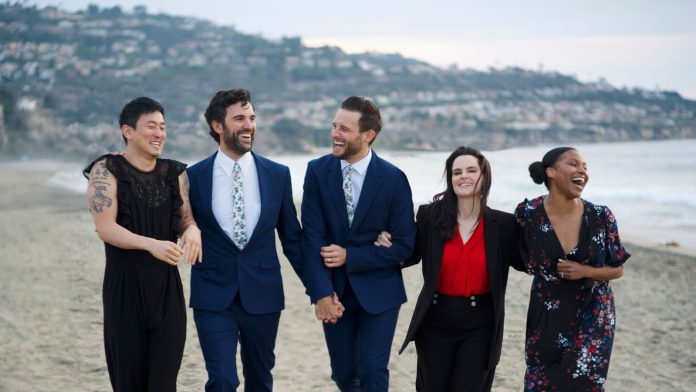

The Mattachine Family offers a poignant exploration of queer families and the changing perceptions of parenthood. The narrative follows Thomas (Nico Tortorella) and Oscar (Juan Pablo Di Pace) as they navigate their evolving views on parenthood following the departure of their foster child. Through this story, the Vallentines delve into the diverse ways queer couples can build families. The film’s powerful ensemble cast enhances its thoughtfully executed message. As Thomas relies on his community for support in the film, the Vallentines themselves built a strong network of trust and collaboration to bring their vision to life.
Ahead of the film’s screening at the Outfest Film Festival in Los Angeles, CA, Andy and Danny Vallentine spoke with No Film School about the inspiration for the project, maintaining a balanced creative partnership, and essential considerations for indie filmmakers on set.
THE MATTACHINE FAMILY (Clip) – Frameline47
No Film School: Congratulations on having your film featured in festivals, allowing it to reach a wide audience. What inspired this story, and how did you decide to develop it into a feature-length film?
Andy Vallentine: Danny has always been a writer, and I’ve always been a director. We’ve been married for almost a decade, but our joint creative journey began about five years ago, after being in the industry for some time. We wanted to collaborate on something personal, drawing from our experiences and expertise. As we reflected, we realized that some of our most intense discussions revolved around our future and whether we wanted children.
Danny Vallentine: These discussions served as a powerful tool for self-reflection. I searched for films that echoed our experiences but found none that truly resonated. While many films focus on queer women as parents, there was a lack of representation for men in similar roles. This motivated us to write a film that not only addressed our questions but also filled a gap we perceived in storytelling. The film draws heavily from our own conversations about fostering, adoption, and surrogacy, as well as insights from friends on similar journeys. Our goal was to explore the various dynamics of queer families and create a narrative space inclusive of diverse relationships.
The story organically expanded to include different family-building paths because we know people who have fostered, adopted, and used surrogacy. While the movie doesn’t directly mirror our lives, it reflects our inquiries into the possibilities open to us as queer parents. The theme of chosen family, so vital in queer history, is woven with new opportunities the future holds. Our film aims to honor the past while embracing the present.
For many straight couples, the path to parenthood is straightforward, but for queer people, it’s often a more complex discussion about the various routes available. We wanted Thomas, portrayed by Nico, to explore these diverse avenues of becoming a parent, enriched by the experiences of other characters like Annie [Funke] and Oscar.
NFS: I appreciated the narrative structure, blending classic storytelling with voiceover elements. Was this always the plan during the writing stage?
Danny Vallentine: We refer to them as narrative narrated sequences, which were integral from the start. When Thomas’s character became a photographer, incorporating photography into the film seemed natural. It allowed us to portray Thomas as an observer, reflecting on his life and relationships through imagery.
NFS: You collaborated with Sean Cook on the film’s photography. What was that experience like?
Danny Vallentine: Sean was my college roommate at Michigan State.
Andy Vallentine: Sean, a talented wedding photographer from the Midwest, captured our wedding in Paris. I wanted Thomas to have a distinct visual perspective, different from mine or my cinematographer Julia Swain’s. Sean spent six days on set, crafting unique images that truly enriched the film.
NFS: The production sounds like a family affair. How long was the principal shooting?
Andy Vallentine: We had a 20-day shoot with an additional day in New York for a montage with Nico. Indie films often have tight schedules, and our 20-day timeframe was challenging yet rewarding. Balancing creative aspirations with budgetary constraints required compromises, but we managed to capture our vision.
NFS: What unexpected challenges did you face, and how did you overcome them?
Danny Vallentine: Writing without considering logistical constraints was new to me. Initially, letting go of scenes I felt attached to was tough, but collaboration taught me the importance of adaptability. As a writer, learning to refine your work in collaboration with others is crucial.
Andy Vallentine: A significant challenge arose when we had to change the location of a pivotal scene due to budget issues. We adapted by relocating to a motel, which required script modifications. Despite this limitation, the actors delivered compelling performances that maintained audience engagement.
NFS: How do you support each other creatively during challenging times?
Andy Vallentine: We’ve been together for nearly 14 years, so our understanding of each other is deep. When challenges arise, Danny’s calm presence often steadies me.
Danny Vallentine: Andy’s experience on set helps me see past the immediate crisis. His pragmatic approach reassures me, allowing us to navigate difficulties together.
NFS: What advice do you have for aspiring filmmakers looking to collaborate with trusted partners?
Danny Vallentine: Write stories that are deeply personal and meaningful to you. Authenticity resonates with others, and when people sense the passion behind your work, they respond positively.
Andy Vallentine: Keep creating, no matter the scale. Collaborate on small projects to build your skills and relationships. It may take time to achieve your goals, but perseverance and positivity are key. Building strong connections within the filmmaking community is invaluable, and maintaining a positive attitude helps overcome challenges on set.