

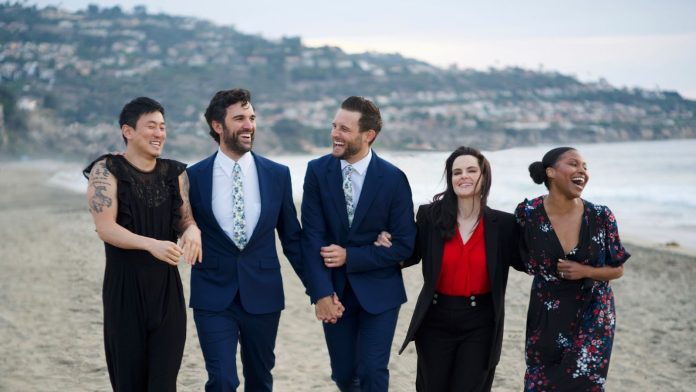

One compelling reason many individuals pursue careers as screenwriters, directors, or storytellers is the desire to share meaningful narratives with a broad audience. Andy and Danny Vallentine’s debut feature film, *The Mattachine Family*, emerges as a poignant reflection of this aspiration, deeply resonating with their personal experiences and community.
*The Mattachine Family* offers a nuanced exploration of queer family dynamics and modern parenthood. The story revolves around Thomas (played by Nico Tortorella) and Oscar (played by Juan Pablo Di Pace), whose ideas about parenthood evolve following their experience with a foster child. The Vallentines skillfully broaden the conversation to include various paths queer couples might take to form families. The film’s ensemble cast significantly elevates the carefully curated narrative, mirroring the Vallentines’ own journey of building a supportive and trusted creative team during production.
Before the film’s screening at the Outfest Film Festival in Los Angeles, Andy and Danny Vallentine shared insights with No Film School about the project’s inspiration, balancing their creative collaboration, and offering essential advice for indie filmmakers.
No Film School: Congratulations on your film’s presence in the festival circuit. What inspired the story, and how did it evolve into a feature-length project?
Andy Vallentine: Danny’s been a lifelong writer, and I’ve been directing for some time. After nearly a decade of marriage, we started collaborating creatively about five years ago. The industry often advises that your first indie film should be personal, something you deeply understand. Our conversations often revolved around questions of our future and the possibility of parenthood, prompting us to draw from these personal experiences for the film.
Danny Vallentine: I found these discussions insightful for understanding my own life. Searching for films that reflected our journey was challenging, particularly regarding queer male parents. Recognizing this gap motivated us to write the screenplay, incorporating our experiences and those of our friends in exploring fostering, adoption, and surrogacy. Our intention was to present a diverse spectrum of queer family dynamics, rooted in real-life conversations and experiences.
Our friends’ varied paths to parenthood—through fostering, adoption, sperm donation, and surrogacy—influenced the film’s organic evolution. While not an exact portrayal of our lives, it reflects our queries about queer parenting and the integration of chosen family ideals with emerging opportunities.
NFS: The narrative structure is intriguing, blending traditional storytelling with distinctive voiceover sequences. Did this format develop during the writing stage?
Danny Vallentine: Yes, we referred to them as ‘narrative narrated sequences.’ Early on, we decided Thomas would be a photographer, leading us to integrate photography into his character’s narrative. This approach allowed us to delve into his thoughts and past connections through images, adding depth to his story.
NFS: Collaborating with Sean Cook on the film’s photography must have been unique. How did that partnership influence the project?
Danny Vallentine: Sean was my college roommate at Michigan State, and he’s an exceptional wedding photographer. He captured our wedding and those of my siblings. We wanted fresh, unique perspectives for Thomas’s character, distinct from my own as a director. Sean joined us for six days, capturing all the photos during production, often shooting in parallel with film scenes. His contribution was invaluable, and it was special to involve someone we’ve known for 23 years in this project.
NFS: The production seems like a family affair. How long did principal photography take?
Andy Vallentine: We filmed over 20 days, with an additional pick-up day in New York for a montage scene. Indie films typically shoot within 15 to 25 days, and we fell in the middle. Filmmaking involves constant compromise based on available resources, requiring flexibility and adaptation. Some days allowed for creative freedom, while others demanded efficiency due to budget constraints.
NFS: Facing unexpected challenges, how did you both support each other creatively?
Andy Vallentine: Our long-standing relationship means we know each other well, but we also influence each other emotionally during crises.
Danny Vallentine: Contrary to that, Andy’s calmness and experience on set help me manage perceived challenges. His pragmatic approach reassures me during stressful moments.
NFS: Any advice for aspiring writers or directors looking to collaborate creatively?
Danny Vallentine: Write a story that feels essential for you to tell. Authentic passion resonates with others.
Andy Vallentine: Keep creating, regardless of scale. Build relationships within the filmmaking community, maintain positivity, and remember that success often requires perseverance.
NFS: Anything else you’d like to share?
Andy Vallentine: Follow *The Mattachine Family*’s journey. We’ve been accepted into 15 film festivals, with more announcements to come, which is incredibly exciting.