

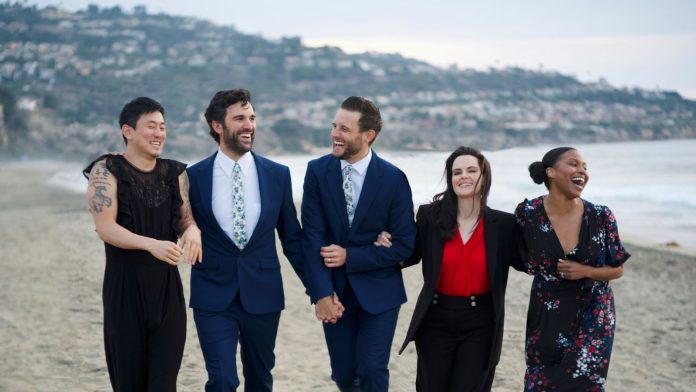

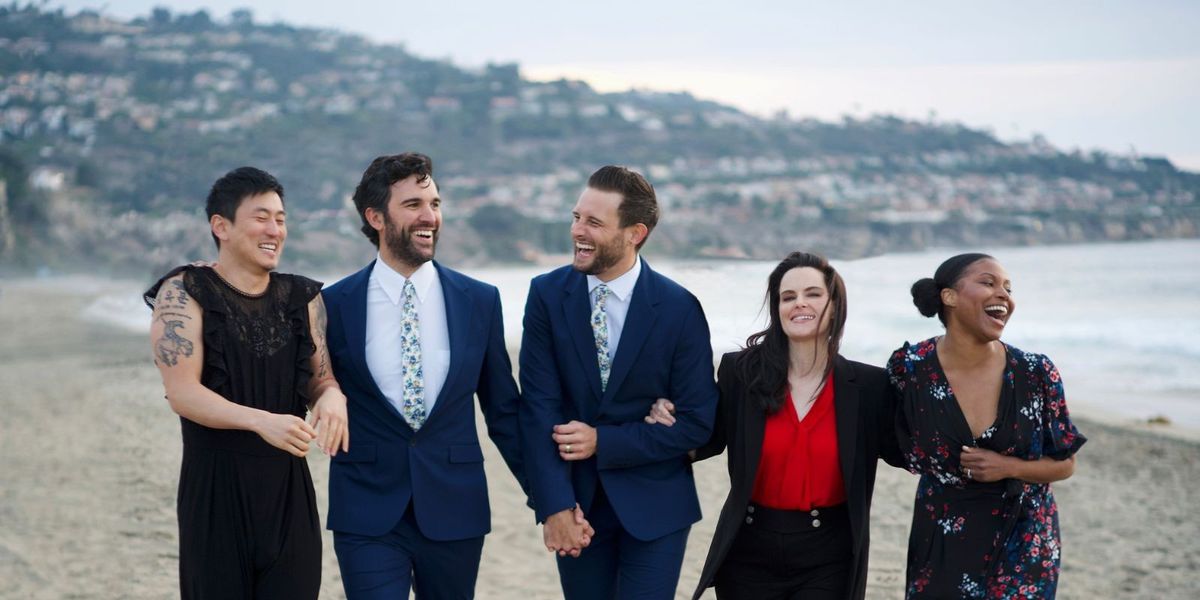
THE MATTACHINE FAMILY (Clip) – Frameline47
Editor’s Note: This interview has been edited for length and clarity.
No Film School: Congratulations on bringing your film to the festival circuit. It’s quite special, and I hope many people get to experience it. What inspired this story, and how did you decide to develop it into a feature-length project?
Andy Vallentine: Danny has always been a writer, and I’ve always been a director. We’ve been married for nearly a decade, but our creative collaboration began about five years ago. They often say to make your first indie film personal, drawing from your own expertise. We looked at our relationship and realized some of our more intense discussions revolved around our future together, including whether or not to have children.
Danny Vallentine: For me, those discussions were a powerful way to understand my own life. I searched for films that addressed what we were going through but found very few, particularly about men becoming parents. To address this gap, we started writing a film. Much of the story is inspired by our experiences and conversations with friends making their own families. We wanted to explore various queer family dynamics, rather than focusing on one specific type. Was this intentional from the start or did it develop naturally as you wrote?
The diversity of family dynamics emerged organically. We have friends who have fostered, adopted, used sperm donors, or chosen surrogacy. While the movie isn’t an exact reflection of our lives, it mirrors questions we had about options available to us and what it means to be a queer parent. It connects past concepts, like chosen family, with new opportunities.
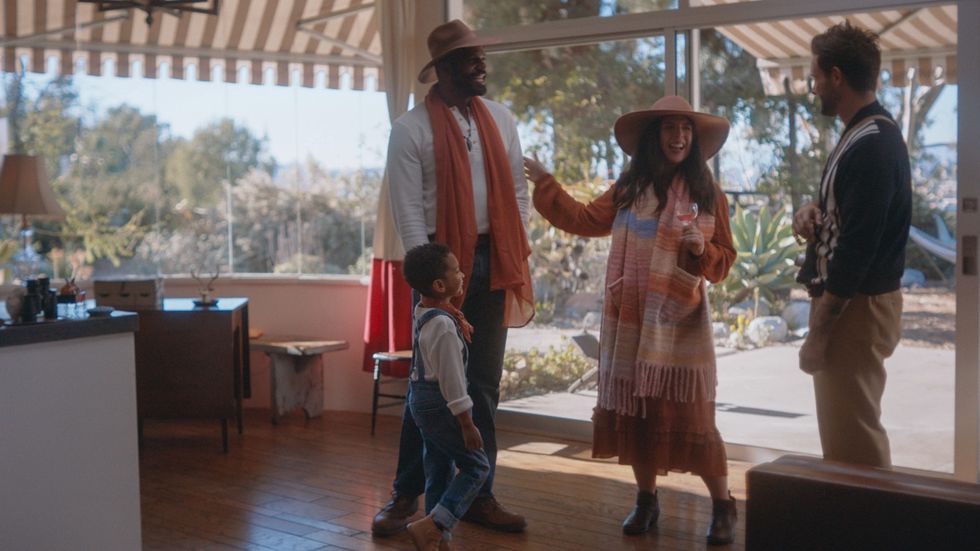
For many straight couples, deciding to have children is straightforward, but for queer couples, there’s more discussion involved. We set Thomas, Nico [Tortorella]’s character, on a journey to explore different paths to parenthood. His interactions with Annie [Funke] and Oscar illustrate this diverse exploration.
NFS: I appreciated the narrative structure with its classic moments interspersed with voiceover inserts. Was this format present from the beginning?
Danny Vallentine: We call them narrative narrated sequences, and they were there from the start. When I decided Thomas would be a photographer, it allowed us to incorporate photography naturally. We wanted to depict Thomas as an observer, connecting with his past and loved ones through photographs.
NFS: You collaborated with Sean Cook on creating these beautiful images for the film. What was that like?
Danny Vallentine: Sean was my college roommate at Michigan State.
Andy Vallentine: Sean is a talented wedding photographer in the Midwest. He photographed our wedding in Paris and those of my siblings. I wanted Thomas’s eye to be distinct from mine and my cinematographer Julia [Swain]’s, so I asked Sean to bring his unique perspective. We shot all the photos in six days, which was a logistical challenge but a rewarding experience.
NFS: This feels like a family production. How long was the principal photography?
Andy Vallentine: It spanned 20 days plus a pick-up day in New York for a montage with Nico. Indie films typically shoot in 15 to 25 days. It was challenging, balancing ambitious visions with practical constraints. Some days we shot fewer pages to get every detail right; other days, we had to move quickly due to budget limits.
NFS: That’s a common struggle.
Andy Vallentine: Indeed, even filmmakers with substantial budgets face challenges. In both low-budget and high-budget projects, there are always new obstacles.
NFS: What unexpected challenges arose during writing or filming, and how did you overcome them?
Danny Vallentine: Transitioning from theoretical writing to working within production constraints was challenging. I had to let go of parts I was attached to, learning to collaborate and adapt, which is essential for writers.
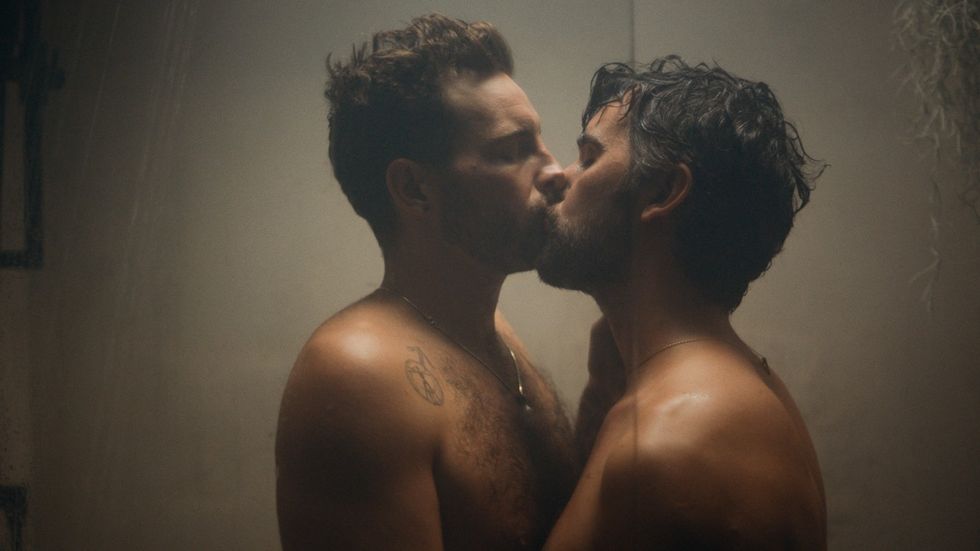
Andy Vallentine: Logistically, we planned to film a scene in a beautiful mansion, but budget constraints led to a last-minute change to a motel setting. It was a challenge to adjust the vision, but with script modifications and strong performances from Nico and Juan Pablo, we created a compelling scene.
NFS: How do you support each other creatively in those tough moments?
Andy Vallentine: We’ve been together for so long, almost 14 years, that we know each other well. When problems arise, we support each other through them.
Danny Vallentine: Andy’s calm presence on set helps me when things feel overwhelming. His experience allows him to stay steady, which reassures me.
Andy Vallentine: On set, I have to make numerous decisions daily, hoping most are correct. I remember when “Moon River” was almost cut due to budget, it was important to us both, so we fought to keep it, knowing its emotional value for the narrative.
NFS: Your partnership is impressive; there’s a deep trust in your creative collaboration.
Andy Vallentine: Thanks for this insightful conversation!
NFS: Do you have advice for aspiring writers or directors, especially those collaborating closely?
Danny Vallentine: This screenplay was deeply personal to us. My advice is to tell the story that only you can tell, one that resonates with you deeply. Others will feel that authenticity and connect with it.
Andy Vallentine: Keep creating. We’ve collaborated on various projects, even small ones, throughout our relationship. It took me 12 years in the industry to direct a feature film. Building a supportive community and maintaining positivity is crucial.
NFS: Anything else you’d like to mention?
Andy Vallentine: Follow us at Mattachine Family. We’ve been accepted into 15 film festivals so far, with more announcements upcoming. We’re excited to share our journey with more audiences.